
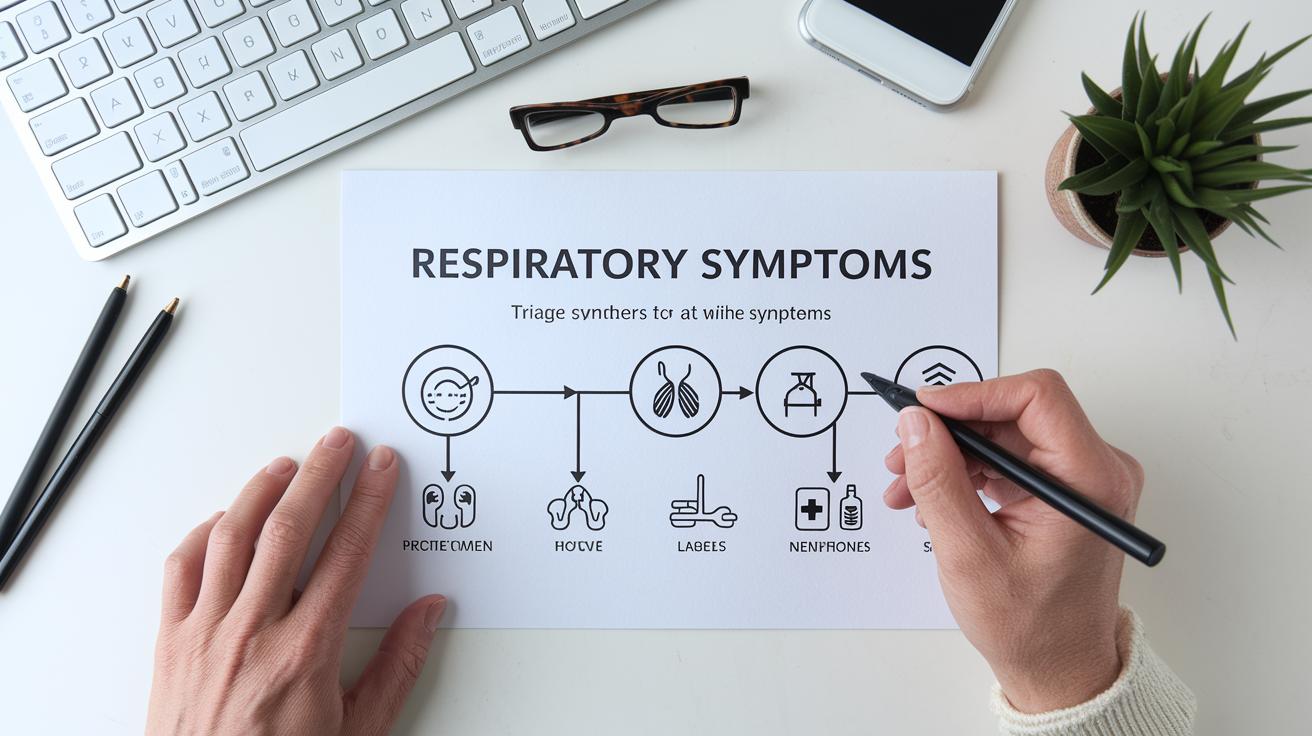

Ever wonder if your shortness of breath signals more than just stress? If you feel out of breath or gasping for air, you might need urgent help. This flowchart offers simple checks that show you when to call emergency services or look after yourself at home. It turns complex symptoms into clear steps so you can decide quickly if you need care or can monitor your condition. Read on to discover how clear, quick decisions about your breathing can help keep you safe.
triage flowchart for respiratory symptoms: Clear & Quick
Quick Take: Use these simple checks to decide if you need urgent care.
Triage Box:
If you have any of these signs, call emergency services now:
- Can’t breathe freely or complete a full sentence without gasping.
- Breathing more than 30 times per minute.
- Oxygen level (SpO₂) is below 92%.
- Feeling confused or unusually disoriented.
This flowchart guides you through three basic checks: can you breathe easily (airway patency), are you breathing hard or fast (breathing effort), and is your pulse strong (circulation). Start by checking if you can breathe clearly. Then note if breathing is very rapid or if extra muscles are working hard to help you breathe. Finally, look at your pulse to see if it feels weak.
If you see any red flags, get help immediately. For someone who struggles to speak due to gasping, it means urgent action is needed. If you don’t see these warning signs, follow home care advice and keep a close eye on your symptoms.
Color-coded steps in the chart make it clear whether to stay at home or head to the emergency room. This approach ties each warning sign directly to the next action so you can act quickly and safely.
Initial Evaluation Criteria in a Respiratory Triage Algorithm

This guide shows you the key vital signs and red flags that tell you whether you need home care, same-day help, or emergency services. Check the flowchart for a clear map of your next steps.
Watch for these signs:
- Breathing rate over 30 breaths per minute.
- Oxygen level (SpO₂) below 92% on room air.
- Extra muscle use when breathing (your neck or chest working hard).
- Trouble speaking in full sentences, which may mean you are in severe distress.
- A sudden start of difficulty breathing or chest pain, especially if you have a history of lung issues.
Each of these points helps you decide the care you need right now.
Severity Index and Patient Prioritization Guidelines in a Respiratory Triage Flowchart
Quick Take: Four clear levels help you or your care team decide how quickly to act.
Triage Box:
• Call emergency services now if you feel very confused or cannot stay awake.
• Seek urgent care if your oxygen level falls under 90% or you have obvious trouble breathing.
• If your oxygen reading is between 90% and 92% and you notice extra effort in breathing, get evaluation from an outpatient provider today.
• If you feel fine with normal oxygen levels, keep monitoring and use self-care.
These guidelines let you quickly sort patients by the signs they show so that care is prompt if symptoms get worse. We check four main levels:
For the Mild level, you have normal oxygen and no signs of distress. With the Moderate level, you may experience slight trouble breathing and oxygen readings from 90% to 92%, which means you need to see a health professional soon. If you are in the Severe group with clear breathing trouble or oxygen below 90%, you need immediate emergency care. And when serious signs of respiratory failure appear, like severe confusion, that is Critical and calls for life-saving measures without delay.
| Severity Level | Signs | What to Do |
|---|---|---|
| Mild | No breathing trouble, normal oxygen | Practice self-care and keep an eye on symptoms |
| Moderate | Fast breathing, oxygen 90-92% | Visit an urgent outpatient clinic |
| Severe | Oxygen under 90%, clear distress | Head to the emergency department right away |
| Critical | Signs of breathing failure (for example, severe confusion) | Activate emergency code immediately |
These steps are designed to help you act fast and safely when breathing problems occur.
Differential Diagnosis Pathway Within the Respiratory Triage Flowchart

Quick take: Breathing issues can stem from asthma, infection, or other lung problems. If you experience severe breathing trouble or sharp chest pain, call emergency services now.
Red Flags – Call Emergency Services Now if you have:
- Severe difficulty breathing or rapid, shallow breaths
- Intense, sharp chest pain or confusion
- Blue lips or face
Urgent – Seek Same-Day Medical Attention if you notice:
- A high fever (above 100.4°F or 38°C) with a cough
- Worsening breathing problems despite using your inhaler
- New or spreading symptoms like confusion or fatigue
Watch and Self-Manage – Monitor Your Symptoms if you experience:
- Mild wheezing or occasional chest tightness
- Gradual changes that improve with rest and simple care
Asthma Exacerbation
If you have asthma, you might feel wheezing and tightness in your chest. You may notice quick relief after using an inhaler like albuterol (a medication that opens your airways). These symptoms usually appear suddenly without a fever. A lung exam that finds wheezing on both sides often supports an asthma flare-up. Try a brief trial of inhaled therapy to help tell it apart from other issues.
Pneumonia and Infectious Causes
When you have a fever over 100.4°F (38°C) along with a cough and crackling sounds (small popping sounds) in one area of your lung, pneumonia becomes a concern. A chest X-ray helps show if there are any spots (infiltrates) on your lungs. Also, if you have signs of COVID-19, like a recent exposure or extra breathing difficulties, you may need isolation and a PCR test (a lab test to detect the virus). This approach uses a fever cutoff to separate infections from non-infectious causes.
Other Pulmonary Conditions
If your symptoms do not quite fit those of asthma or pneumonia, other lung issues might be at play. For instance, a flare-up of COPD (chronic obstructive pulmonary disease) can bring a worsening cough and more mucus. In contrast, a pulmonary embolism (a blood clot in the lung) might cause sudden, sharp chest pain and shortness of breath. Also, signs of an allergic reaction, like hives or swelling in your face, need fast attention. Tests such as a D-dimer (a blood test that checks for clots) or using a Wells score (a tool to estimate blood clot risk) can help guide further care.
Best Practice Protocols and Guidelines for Respiratory Triage Flowcharts
Quick take: Follow trusted, proven guidelines to decide quickly between home care and emergency treatment.
If you notice any of these emergency signs, severe shortness of breath, very low oxygen levels, or unstable vital signs, call emergency services immediately. If breathing worsens or you see other urgent signs, seek care the same day. Otherwise, follow the outlined steps to manage symptoms safely.
Good protocols make triage smooth and reliable. Trusted tools like the CDC COVID-19 screening tool, the ATS/IDSA pneumonia guidelines, and ACEP triage standards give you clear, evidence-based direction. Using these sources helps create a steady, consistent flow for making decisions.
A typical triage checklist includes:
- Recording vital signs on arrival
- Checking breathing effort
- Noting any red flags (sudden changes or danger signs)
- Confirming oxygen saturation levels
When your findings hit key thresholds, the flowchart points you to the right care, whether that’s managing at home or activating hospital resources immediately. Sticking to this clear and uniform plan minimizes mistakes and boosts the confidence of everyone involved in the assessment.
Implementing the Respiratory Triage Flowchart: Training and Tools

Training is very important. Use simulation drills to practice real-life scenarios and test your response times. Do telephone role-play sessions so your team can speak clearly and calmly when they assess patients over the phone. Give each team member a checklist to confirm they know the flowchart steps and decision rules.
Equip your facility with simple tools to help everyone follow the flowchart. Hang wall-chart posters in key spots as reminders. Add electronic decision-support tools into your current systems so you can access guidelines right away during calls. Use mobile-app prompts to keep the process clear and reduce delays.
Check your quality often. Audit call-to-decision times, track patient outcomes, and review protocols regularly. These steps help you spot problems and keep your practice running smoothly.
Final Words
In the action, this guide broke down a clear pathway from initial evaluation to urgent care using a triage flowchart for respiratory symptoms. We touched on key decision points like airway status, breathing signs, and red flags. The article explained how to sort patients from mild discomfort to critical distress, including practical tools and tips for accurate symptom tracking. Each section pointed you toward actionable steps and reliable protocols. Stay informed and ready to act, and remember that taking charge of these signs can bring you closer to the care you need.
FAQ
Triage Chart example
The triage chart example shows a visual decision tree that groups patients by symptoms and vital signs to quickly determine the urgency of care and next steps.
Triage chart pdf
The triage chart PDF provides a printable guide outlining key steps and decision points based on symptom severity, making it easy to use for rapid patient sorting.
Telephone triage flowchart
The telephone triage flowchart offers a structured set of questions and actions to help clinicians assess patients over the phone, ensuring timely and safe recommendations.
Emergency triage chart
The emergency triage chart organizes patients by urgency, highlighting red-flag signs and guiding immediate actions to ensure those with the most critical conditions receive prompt care.
Telephone triage protocols for nurses PDF
The telephone triage protocols for nurses PDF details guidelines and algorithms that assist nurses in asking the right questions and deciding on necessary actions during patient calls.
Triage flowchart for general practice uk
The triage flowchart for general practice in the UK provides primary care staff a step-by-step guide to assess symptoms, ensuring patients are prioritized consistently based on urgency.
Triage protocol PDF
The triage protocol PDF delivers a detailed document outlining standardized questions, decision pathways, and recommended actions to streamline patient evaluation and care prioritization.
Triage protocol for non clinical staff
The triage protocol for non clinical staff offers simple, clear guidelines and decision aids to help administrative personnel direct patients safely to the correct care setting.
What are the triage questions for upper respiratory infection?
The triage questions for upper respiratory infection cover symptoms such as cough, sore throat, fever, and breathing difficulties, aiming to identify red flags and decide if urgent care is needed.
What are the 5 levels of triage?
The five levels of triage classify patients from nonurgent to critical, using categories that prioritize routine, urgent, immediate, and expectant care based on symptom severity and vital signs.
When using the start triage system, a patient who is breathing faster than 30 breaths/min is triaged as?
When a patient is breathing faster than 30 breaths per minute, the start triage system categorizes them as having severe distress, prompting a need for urgent or immediate evaluation.
What triage category is chest pain?
Chest pain typically falls into the immediate or urgent category, as it may signal a serious condition; red flags like severe pain or shortness of breath require prompt medical attention.